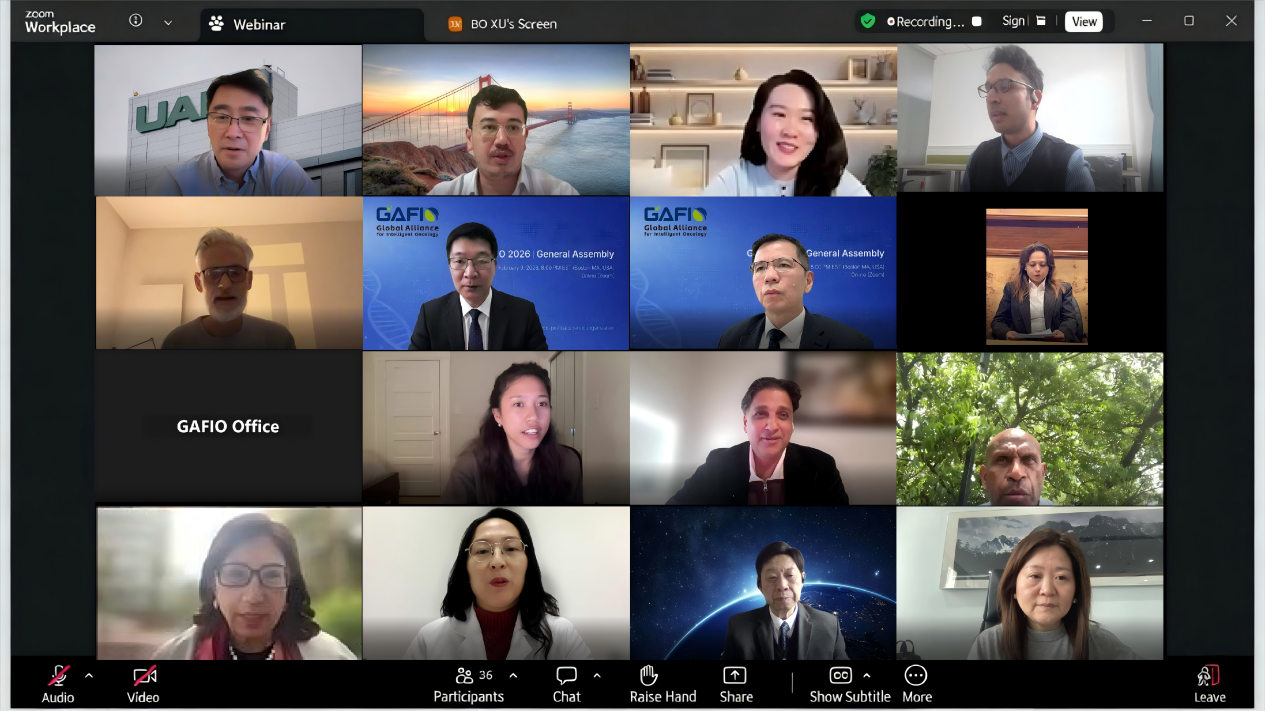
February 9, 2026 (BOSTON, MA) – The Global Alliance for Intelligent Oncology (GAFIO), an international non-profit academic organization, convened its Inaugural General Assembly, marking the official launch of a global academic alliance dedicated to advancing intelligent oncology. The online Assembly brought together founding members, professors from leading global institutions, and distinguished experts in oncology, artificial intelligent, medical imaging, pathology, translational research, and digital health from North America, Asia, and Europe. During the meeting, participants formally launched the Alliance and outlined its strategic vision for advancing the responsible integration of artificial intelligence into cancer research and clinical care.
The Assembly was moderated by Laras Kamila, Secretary of GAFIO. Professor Bo Xu, President of GAFIO and Founding Editor-in-Chief of the journal Intelligent Oncology, delivered the keynote address. In his speech, Professor Xu articulated the core mission of GAFIO: to accelerate the clinical translation of AI in oncology and to foster global, interdisciplinary collaboration to reshape the cancer care ecosystem. He emphasized that intelligent oncology addresses critical challenges in healthcare: addressing inefficiency, managing uncertainty, and discovering the unknown.
Following the keynote, Professor Wenli Cai, Executive Director of GAFIO, presented the Alliance's governance structure. Designed to ensure inclusivity, transparency, and sustainability, GAFIO’s structure includes a Board of Directors for strategic oversight, an Executive Committee for operational leadership, and the Academy of Intelligent Oncology as the academic core. Professor Cai also introduced key functional committees dedicated to International Affairs, Nominations, Publications, and Fundraising, all supported by the Alliance Secretariat.
A central focus of the Assembly was the official call for global participation. Professor Feng-Ming (Spring) Kong from the University of Hong Kong presented the initiative to recruit leaders and members for GAFIO's Scientific Committees and Regional Chapters. She outlined the vision for building strong regional hubs worldwide and forming specialized scientific committees dedicated to setting standards, driving innovation, and ensuring scientific rigor, quality and clinical impact in intelligent oncology research.
The Assembly featured a dynamic discussion session with insights from a diverse panel of global experts. Professor Andrea Cavalli (Switzerland) shared perspectives on AI-driven cancer drug discovery at the intersection of immunology and oncology. Professor Syed Rahmanuddin (USA) emphasized promoting global intelligent oncology through standardized imaging biomarkers and clinical trial innovation. Professor Dong Jin (China) outlined China's approach to building integrated data systems and deploying AI across the cancer care continuum.
Professor June-Goo Lee (Korea) highlighted the advances in multimodal AI research and the opportunities by new infrastructure like heavy ion therapy centers. Early-career scientist Laney Zhang (USA) proposed empowering the next generation through dedicated subcommittees, emphasizing community building and professional development. Professor Jake Y. Chen (USA) envisioned a future of rapid, personalized cancer therapy powered by integrated bioinformatics and AI networks. Professor Chunling Jiang (China) described the shift from image-guided to biology-driven intelligent radiotherapy. Dr. Xiaomei Wang (Canada) showcased the real-world clinical adoption of AI in pathology for both drug discovery and diagnostic applications.Professor Shareen Fawaz (Egypt) advocated for partnership-driven intelligent oncology in diverse regions, highlighting collaboration in AI research, capacity building, and ethical clinical implementation. Dr. Arnold Waine (Papua New Guinea) addressed cancer care challenges in Pacific Island nations and emphasized AI’s potential for improving diagnosis, treatment guidance, and research in resource-limited settings. Additional contributions were made by Professor Ijaz Gul (Pakistan), who emphasized the need for cost-effective molecular diagnostic tools, and Professor Sanatbek Matlatipov (Uzbekistan), who highlighted the importance of practical collaboration mechanisms to overcome global barriers.
In his closing remarks, Professor Wenli Cai expressed sincere appreciation to all participants for their commitment. "GAFIO is built on a foundation of trust, transparency, and multidisciplinary leadership," he stated. "Our success will depend on your active participation—contributing ideas, leading initiatives, and bridging innovation with real-world clinical impact across regions."
GAFIO extends an open invitation to researchers, clinicians, AI scientists, and institutions worldwide to join its committees, form regional chapters, and collaborate in advancing the global research and development in intelligent oncology.
About GAFIO:
The GAFIO is a non-profit international academic organization registered in the United States under the Section 501(c)(3). Founded in collaboration with professors from Harvard, Cornell, Stanford, UC system, University of Toronto, ETH Zurich, and other leading universities. GAFIO aims to advance the development and clinical translation of artificial intelligence in oncology, support international and multidisciplinary collaborative research on AI in oncology, and promote precise and personalized cancer diagnosis and treatment through education, research, and innovation in this emerging field.
Website: http://gafio.org/
Contact:
E-mail: office@gafio.org
Social Media:
Instagram: @GAFIO_01
X (Twitter): @GAFIO_02
