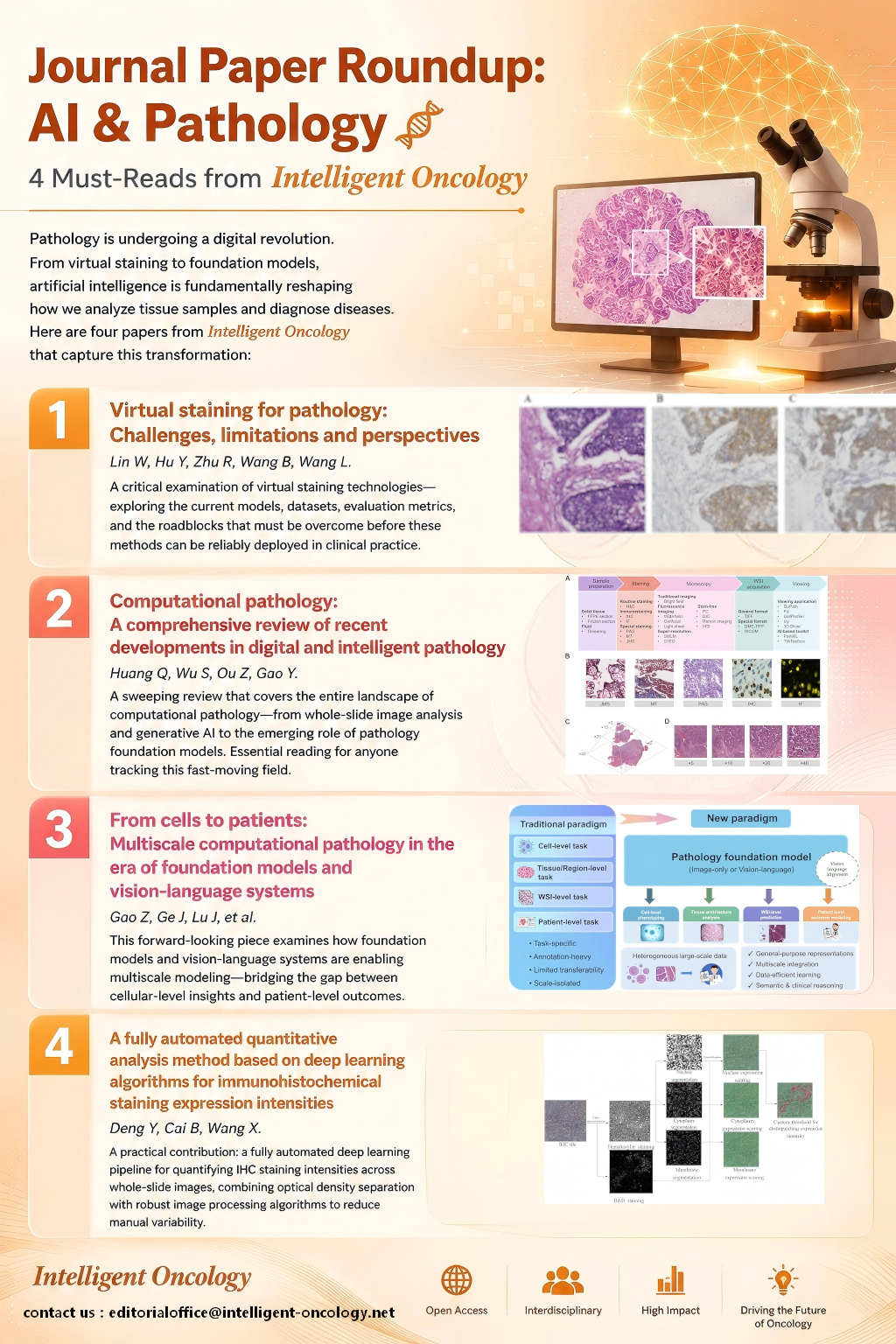
Pathology is undergoing a digital revolution. From virtual staining to foundation models, artificial intelligence is fundamentally reshaping how we analyze tissue samples and diagnose diseases. Here are four papers from Intelligent Oncology that capture this transformation:
1. An examination of virtual staining technologies—exploring the current models, datasets, evaluation metrics, and the roadblocks that must be overcome before these methods can be reliably deployed in clinical practice.
https://doi.org/10.1016/j.intonc.2025.03.005
Lin W, Hu Y, Zhu R, Wang B, Wang L. Virtual staining for pathology: Challenges, limitations and perspectives. Intelligent Oncology. 2025;1(2):105-119. doi:10.1016/j.intonc.2025.03.005
2. A sweeping review that covers the entire landscape of computational pathology—from whole-slide image analysis and generative AI to the emerging role of pathology foundation models—essential reading for anyone tracking this fast-moving field.
https://doi.org/10.1016/j.intonc.2025.03.004
Huang Q, Wu S, Ou Z, Gao Y. Computational pathology: A comprehensive review of recent developments in digital and intelligent pathology. Intelligent Oncology. 2025;1(2):139-159. doi:10.1016/j.intonc.2025.03.004
3. This forward-looking piece examines how foundation models and vision-language systems are enabling multiscale modeling—bridging the gap between cellular-level insights and patient-level outcomes.
https://doi.org/10.1016/j.intonc.2026.100074
Gao Z, Ge J, Lu J, et al. From cells to patients: Multiscale computational pathology in the era of foundation models and vision-language systems. Intelligent Oncology. 2026;2(3):100074. doi:10.1016/j.intonc.2026.100074
4. A practical contribution: a fully automated deep learning pipeline for quantifying IHC staining intensities across whole-slide images, combining optical density separation with robust image processing algorithms to reduce manual variability.
https://doi.org/10.1016/j.intonc.2025.06.001
Deng Y, Cai B, Wang X. A fully automated quantitative analysis method based on deep learning algorithms for immunohistochemical staining expression intensities. Intelligent Oncology. 2025;1(3):256-264. doi:10.1016/j.intonc.2025.06.001
Feel free to share! Stay tuned for more cutting-edge AI-oncology research.
Contact Information for Intelligent Oncology:
LinkedIn: @IntelligentOncology
X: @IntelligentOnco
Facebook: @intelligentoncology
Email Address: editorialoffice@intelligent-oncology.net
Official Website: https://www.sciencedirect.com/journal/intelligent-oncology
Submission Link: https://www2.cloud.editorialmanager.com/intonc/default2.aspx
