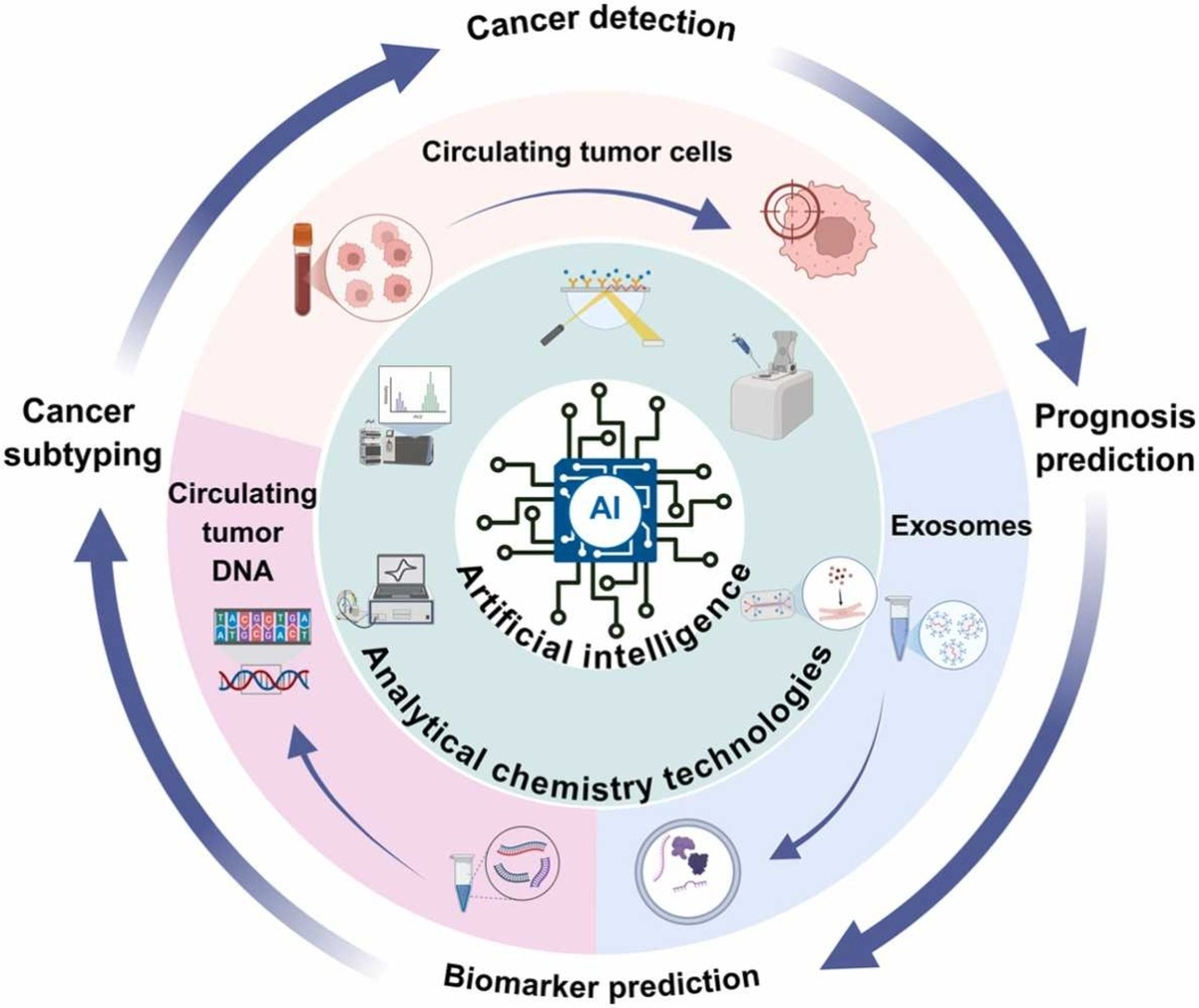
Liquid biopsy offers a minimally invasive approach to detecting tumor-derived biomarkers, yet its clinical translation remains constrained by low biomarker abundance and complex biological matrices. As AI advances, a key question is how computational models can integrate with analytical chemistry platforms to support precision oncology.
A review by Janusz Pawliszyn (University of Waterloo), Lixian Li (Chongqing University Cancer Hospital), and colleagues, published in Intelligent Oncology (Volume 2, Issue 4), evaluates the evolution of AI-assisted analytical chemistry technologies in liquid biopsy and proposes an integrated framework for early cancer detection and clinical decision support.
Highlights:
Bridging analytical chemistry and AI: The review proposes an integrated workflow—from sample enrichment and instrumental detection to AI-assisted signal recognition and clinical application—to overcome the challenges of low-abundance biomarkers in complex biofluids.
From traditional ML to foundation models: The authors detail the evolution of computational strategies, from feature-based machine learning to deep learning, self-supervised transformers, and emerging large language models adapted for multi-omics data integration (cfDNA, CTCs, exosomes).
A persistent translational gap: While AI models (such as the Orion system or Exosome-SERS-AI) demonstrate high sensitivity and AUC values in retrospective datasets, the review emphasizes that benchmark gains do not automatically translate into applied clinical scenarios without robust external validation.
A proposed division of labor: Specialized analytical platforms (mass spectrometry, spectroscopy, microfluidics, electrochemical biosensing) perform precise molecular enrichment and detection, while AI serves as an integrative layer for multi-omics fusion, temporal modeling, and longitudinal disease monitoring.
A key takeaway
The review positions AI not as a standalone diagnostic technology, but as a robust data-generation and integration layer. No single biomarker, analytical platform, or AI model is sufficient to solve the challenges of early cancer detection. The clinical value of AI-assisted liquid biopsy depends on standardized workflows, interpretable outputs, and prospective validation. By making molecular measurement and subsequent reasoning separately reviewable, this integrated approach could help clinical teams trace errors, assess reliability, and ultimately deliver on the promise of precision oncology.
Looking ahead
The next chapter in AI-powered liquid biopsy will likely be defined by three frontiers: multimodal intelligent diagnosis platforms, automated microfluidics-enabled sample-to-answer systems, and advanced multi-omics data fusion. Future systems must prioritize clinically interpretable, reproducible, and scalable architectures. Increasing model complexity alone will not ensure clinical benefit; future research must demonstrate that computational progress translates into reliable, accessible, and equitable clinical care.
Full article available on ScienceDirect:
https://www.sciencedirect.com/science/article/pii/S2950261626000518
Contact Information for Intelligent Oncology:
LinkedIn: @IntelligentOncology
Bluesky: @Intelligent Oncology
X: @IntelligentOnco
Facebook: @intelligentoncology
Email Address: editorialoffice@intelligent-oncology.net
Official Website: https://www.sciencedirect.com/journal/intelligent-oncology
Submission Link: https://www2.cloud.editorialmanager.com/intonc/default2.aspx
