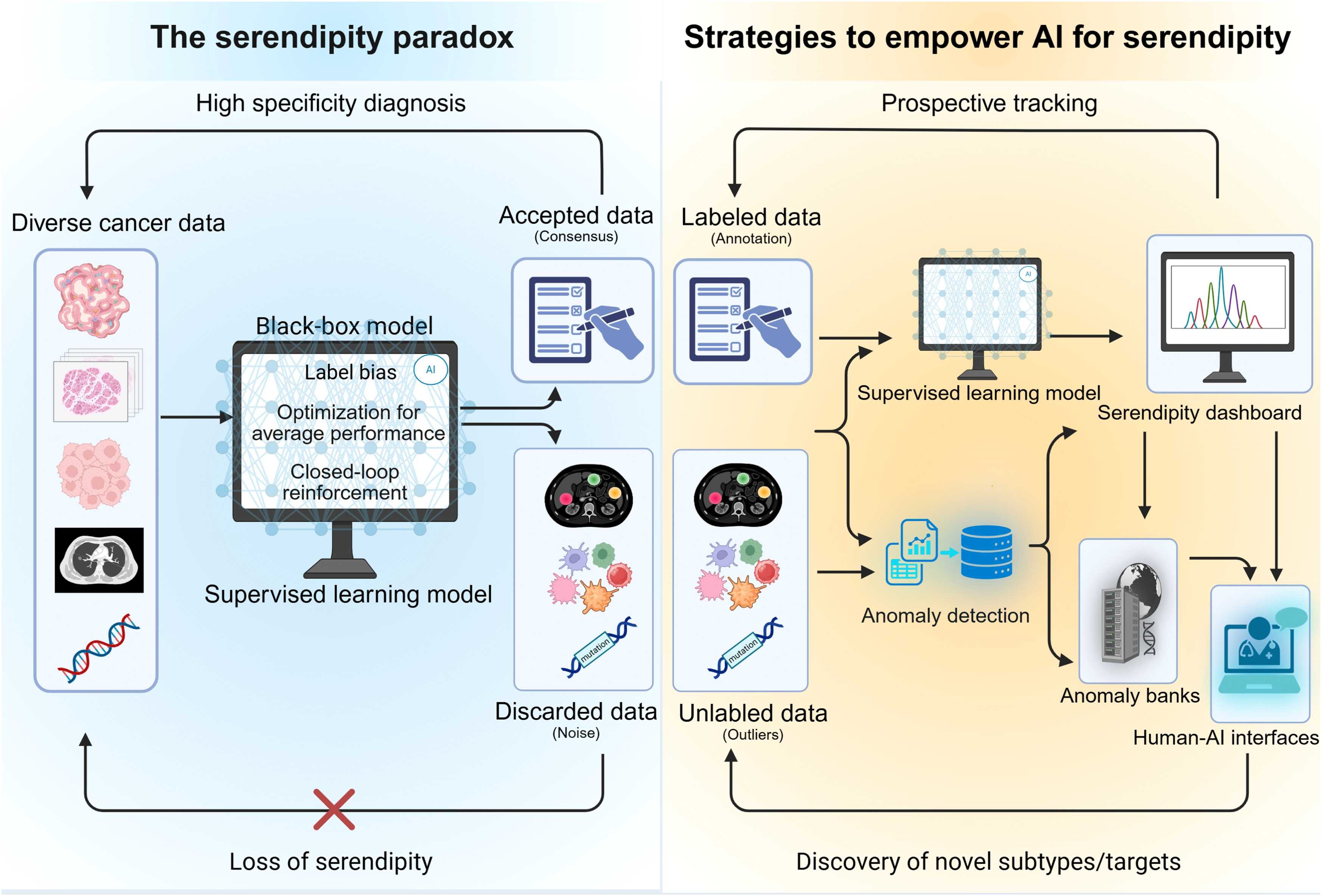
A thought-provoking editorial published in Intelligent Oncology challenges the current AI paradigm in cancer research. Authors Zejia Mao and Professor Bo Xu (Editor-in-Chief) argue that supervised learning and average-performance metrics systematically filter out rare, anomalous, and unclassifiable cases – precisely where breakthrough discoveries often hide. They propose three actionable strategies to reorient AI from mere pattern recognition toward a true engine of productive serendipity.
Key Arguments
The authors identify three mechanisms that kill serendipity in current pipelines:
Label bias—Supervised learning forces every image or genomic profile into existing categories; ambiguous and unclassifiable cases are either discarded or mislabeled, erasing the unknown.
Average performance optimisation—Rare, poor-prognosis subtypes contribute negligibly to loss functions, so models learn to ignore them as noise.
Closed-loop reinforcement—Once deployed, AI systems shape clinical decisions (e.g., fewer biopsies for low-risk predictions), which removes ground-truth feedback and entrenches the original training distribution, creating a self-fulfilling prophecy.
Proposed Strategies
To preserve and prioritise the unexpected, the editorial outlines three design principles:
Anomaly detection as a primary objective—Instead of only classifying malignancy, every clinical case should receive a “strangeness” score. High-strangeness cases, even with low-risk predictions, should be flagged for human tumour board review, turning AI into a scout for the genuinely weird.
Uncertainty-aware human-AI interfaces – Conventional explainability tools tell us “why” a decision was made, but not “when” the model is confused. The authors propose a “serendipity dashboard” that displays epistemic uncertainty, proximity to training data, and residual errors—inviting clinicians to investigate, rather than ignore, the unfamiliar.
Noise-preserving data governance – Data cleaning routinely discards artefacts and low-quality samples, yet “noise” often contains signals we have not yet learned to decode. The editorial recommends creating curated anomaly banks—secondary datasets of excluded cases—and mandates that all AI training sets include a “tail” (bottom 5% by typicality) for dedicated study.
The promise of intelligent oncology lies not only in faster, more accurate diagnosis, but in accelerating discovery—finding new drivers, resistance pathways, and off-target miracles. This requires a fundamental shift from supervised consensus to systems that explicitly retain and highlight the anomalous. The next breakthrough will not come from a model trained on what we already know; it will emerge from the outliers we have the courage to examine.
Full article available on ScienceDirect:
https://doi.org/10.1016/j.intonc.2026.100073
Contact Information for Intelligent Oncology:
LinkedIn: @IntelligentOncology
X: @IntelligentOnco
Facebook: @intelligentoncology
Email Address: editorialoffice@intelligent-oncology.net
Official Website: https://www.sciencedirect.com/journal/intelligent-oncology
Submission Link: https://www2.cloud.editorialmanager.com/intonc/default2.aspx
