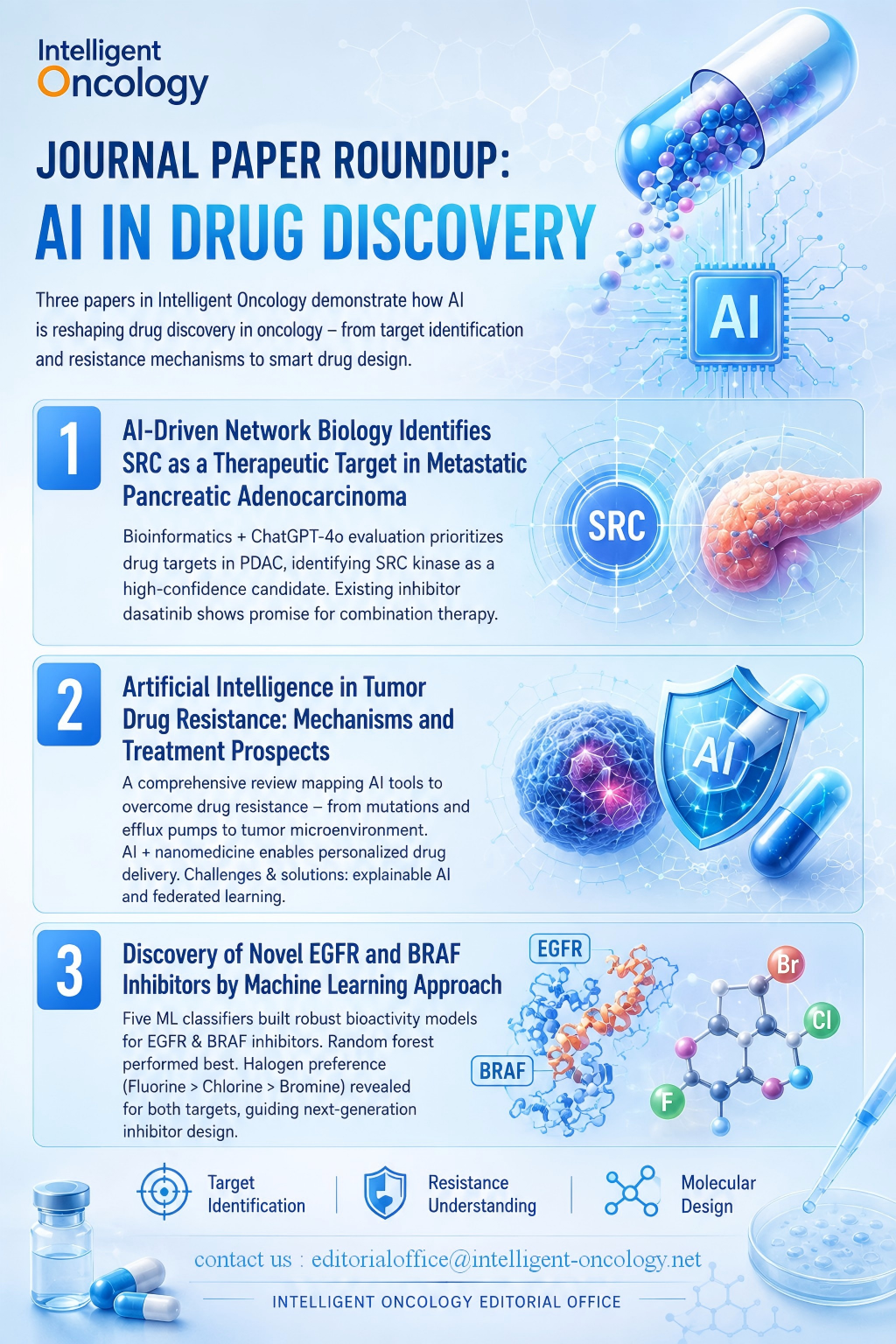
1. AI‑Driven Network Biology Identifies SRC as a Therapeutic Target in Metastatic Pancreatic Adenocarcinoma
https://doi.org/10.1016/j.intonc.2025.06.004
This study combines bioinformatics with a ChatGPT‑4o evaluation framework to systematically prioritise drug targets in pancreatic ductal adenocarcinoma, ultimately identifying SRC kinase as a high‑confidence candidate. Through pathway analysis, differential expression profiling, and survival correlation, the authors show that SRC plays a pivotal role in tumour progression and that existing inhibitors like dasatinib hold promise for combination therapy. The work offers a reusable AI-assisted paradigm for target discovery in a cancer type with few effective options.
2. Artificial Intelligence in Tumor Drug Resistance: Mechanisms and Treatment Prospects
https://doi.org/10.1016/j.intonc.2025.02.001
This comprehensive review maps the entire AI toolkit applied to overcoming drug resistance—from predicting resistance mutations and modelling efflux pumps to dissecting tumour-microenvironment contributions. It also highlights how AI, combined with nanomedicine, can enable personalised drug delivery systems. Importantly, the authors candidly address the challenges of data quality, model interpretability, and ethical/regulatory issues, proposing explainable AI and federated learning as practical solutions to turn resistance from a clinical dead‑end into a manageable challenge.
3. Discovery of Novel EGFR and BRAF Inhibitors by Machine Learning Approach
https://doi.org/10.1016/j.intonc.2024.10.001
Using five machine learning classifiers, the researchers built robust predictive models for EGFR and BRAF inhibitor bioactivity, with random forest outperforming the others. More importantly, substructure frequency analysis revealed a consistent halogen preference—fluorine > chlorine > bromine—for both targets, rationalised by hydrogen-bonding capacity through molecular docking. These findings provide clear chemical guidelines for designing next-generation inhibitors capable of overcoming T790M/C797S resistance.
These three papers illustrate AI's three faces in oncology: discovery (target identification), understanding (resistance), and design (molecular optimisation). Feel free to share! Stay tuned for more cutting-edge AI-oncology research.
Contact Information for Intelligent Oncology:
LinkedIn: @IntelligentOncology
X: @IntelligentOnco
Facebook: @intelligentoncology
Email Address: editorialoffice@intelligent-oncology.net
Official Website: https://www.sciencedirect.com/journal/intelligent-oncology
Submission Link: https://www2.cloud.editorialmanager.com/intonc/default2.aspx
