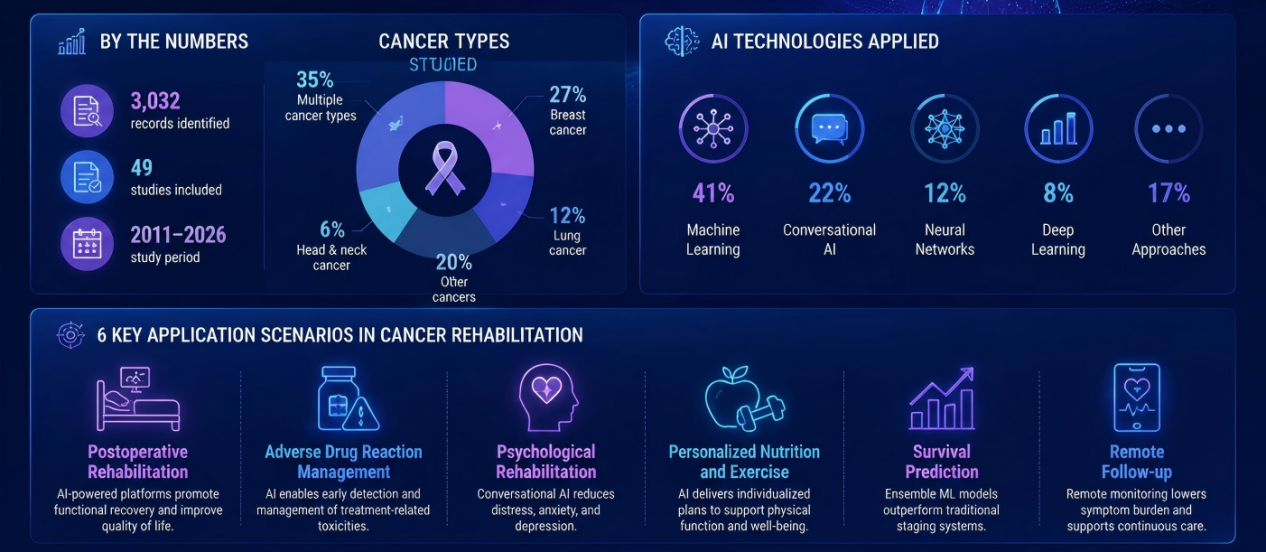
A scoping review published in Intelligent Oncology (Volume 2, Issue 3) provides the first systematic mapping of AI applications across cancer rehabilitation – a field with fragmented evidence despite rapid growth. Following PRISMA‑ScR guidelines, the authors from Chongqing University Cancer Hospital screened 3,032 records across eight databases and identified 49 studies that synthesise evidence on how AI can address persistent challenges in rehabilitation: resource limitations, workforce shortages, and the lack of personalised care.
Key Advances
The review reveals six distinct clinical scenarios where AI is already demonstrating tangible value:
Postoperative functional rehabilitation. AI‑powered intelligent platforms (integrating IoT and wearables) improved functional recovery, quality of life, and self‑efficacy in head and neck, lung, cervical, and oesophageal cancers. Deep learning‑based speech restoration systems for post‑laryngectomy patients consistently outperformed original speech in perceptual evaluations.
Adverse drug reaction management. Real‑time remote monitoring systems (e.g., eSMART, eRAPID) reduced symptom burden and improved quality of life without increasing hospital workload. Conversational AI (chatbots) and risk‑stratification tools (e.g., WeChat mini‑programs for CINV) achieved high risk‑detection rates and resolved alerts within 24 hours.
Psychological and sleep rehabilitation. Conversational AI (Mika, Vik, Vivibot) and personalised AI systems significantly reduced distress, anxiety, and depression. Machine learning identified physical symptoms – particularly fatigue, insomnia, and pain – as the strongest predictors of psychological distress.
Personalised nutrition and exercise. AI‑driven coaching and digital therapeutics improved cardiorespiratory fitness, adherence, and Mediterranean diet compliance, with ML models accurately classifying malnutrition severity linked to survival.
Recurrence, metastasis, and survival prediction. Ensemble ML models (LightGBM, XGBoost, Random Forest) consistently outperformed traditional TNM staging, with AUC values exceeding 0.70 for 2‑year outcomes and high accuracy for distant recurrence and bone metastasis.
Remote follow‑up and long‑term QoL management. AI‑powered follow‑up systems enhanced self‑management, reduced readmission rates, and identified site‑specific QoL predictors (e.g., lymphedema for upper‑limb melanoma, BMI for trunk melanoma).
Implementation Challenges
Despite promising performance, the review identifies critical barriers to real‑world adoption:
Limited evidence quality. Most studies remain at feasibility or pilot stage; few large‑scale, multicentre RCTs exist. The majority of evidence is rated very low to moderate in quality, calling for rigorous, adequately powered trials.
Geographic and cancer‑type skew. Research is heavily concentrated in Asia, Europe, and North America, with no studies from low‑ and middle‑income countries. Breast cancer (27%) and mixed‑cancer types (35%) dominate, while colorectal, gastric, oral, and several other cancers each have only one study (2%).
Short follow‑up and missing data. Few studies extend beyond six months, limiting understanding of durability. Inadequate handling of missing data was the most common methodological limitation (lowest QuADS score).
Under‑addressed psychological rehabilitation. Despite high prevalence of distress, psychological outcomes received considerably less attention than symptom monitoring, leaving a major care gap.
Future Directions
The review outlines five actionable priorities for translating AI into routine cancer rehabilitation practice:
Large‑scale, multicentre RCTs with standardised outcome measures and follow‑up exceeding six months – to validate preliminary findings and establish clinical effectiveness.
Explicit integration with clinical workflows – addressing interoperability (FHIR standards), clinician training, and patient digital literacy to ensure equitable access.
Focus on underserved populations and underrepresented cancers – especially colorectal, gastric, oral, and other solid tumours, as well as resource‑limited settings.
Routine reporting of model calibration and decision‑curve analysis – moving beyond discrimination metrics (AUC) to ensure predicted probabilities translate into net clinical benefit.
Investment in low‑cost, scalable solutions – such as mini‑programs for symptom management – while tackling data privacy, algorithmic bias, and federated learning for collaborative model development.
The promise of intelligent oncology in rehabilitation lies not only in automating symptom monitoring or predicting survival, but in delivering personalised, scalable, and accessible supportive care – transforming survivorship from a fragmented patchwork into a data‑driven, patient‑centred continuum.
Full article available on ScienceDirect:
https://doi.org/10.1016/j.intonc.2026.100068
Contact Information for Intelligent Oncology:
LinkedIn: @IntelligentOncology
X: @IntelligentOnco
Facebook: @intelligentoncology
Email Address: editorialoffice@intelligent-oncology.net
Official Website: https://www.sciencedirect.com/journal/intelligent-oncology
Submission Link: https://www2.cloud.editorialmanager.com/intonc/default2.aspx
