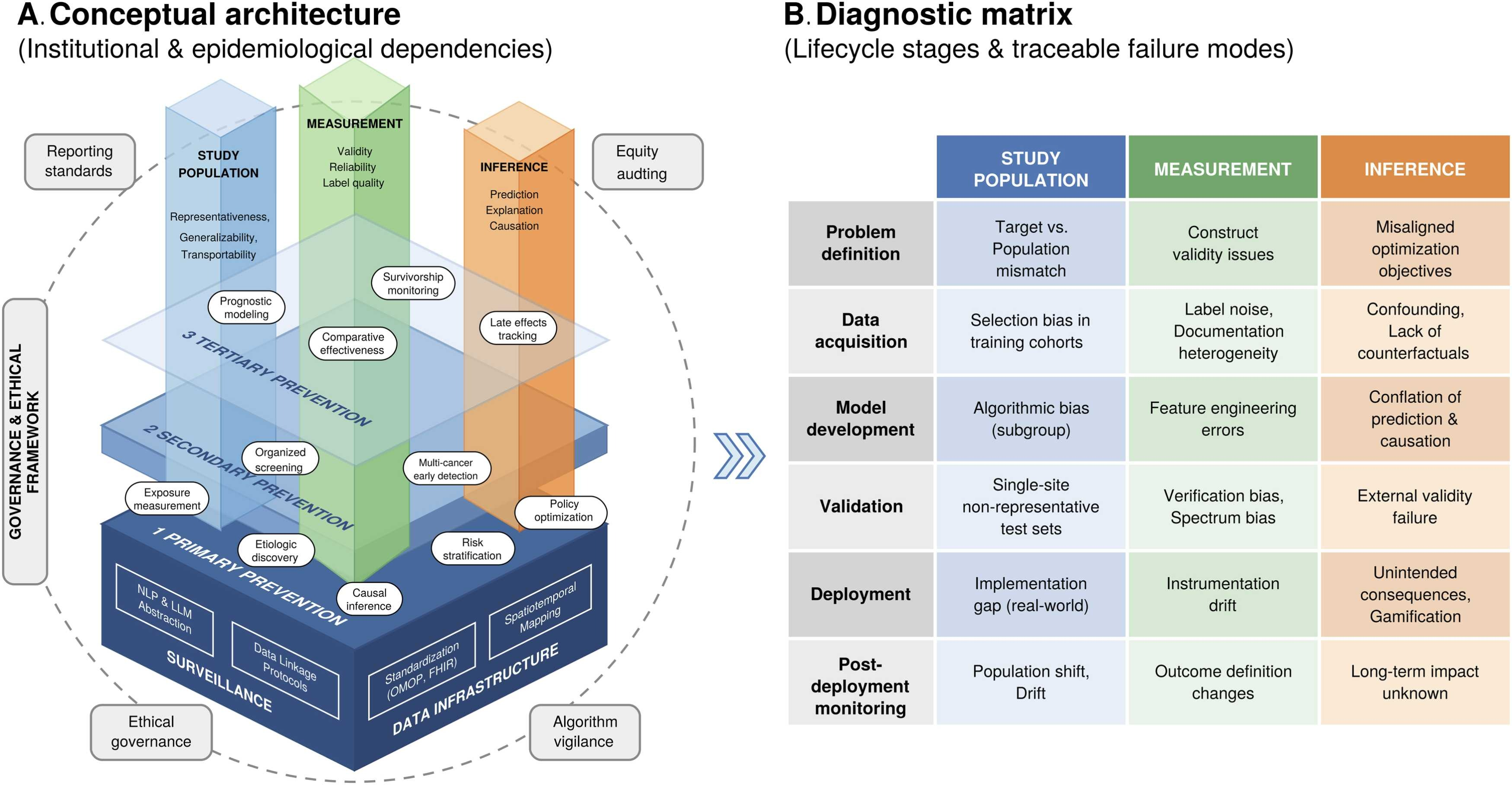
A review published in Intelligent Oncology (Volume 2, Issue 3) provides a comprehensive framework for evaluating AI applications across the full cancer epidemiology continuum — from surveillance and data infrastructure through primary prevention, screening, prognosis, comparative effectiveness, and survivorship. Led by authors from Chongqing University, Monash University, and the University of Melbourne, the paper applies a diagnostic matrix that crosses three epidemiologic pillars (study population, measurement, and inference) with six stages of the AI lifecycle, from problem definition to post-deployment monitoring.
Key Advances
The review maps AI applications across six domains of cancer epidemiology, highlighting both progress and persistent gaps:
Cancer registration and data infrastructure. Natural language processing and large language models are improving automated abstraction from pathology reports, with CancerLLM achieving F1 scores above 91% for phenotype extraction. However, cross-registry transportability and hallucination risks remain incompletely addressed, and confidentiality safeguards vary widely across studies.
Primary prevention: etiology and risk stratification. AI-enhanced exposure assessment — combining satellite-based remote sensing, wearables, and the exposome framework — is enabling high-resolution environmental epidemiology. Causal inference frameworks, including target trial emulation and double/debiased machine learning, offer rigorous pathways to move from AI-discovered associations to actionable prevention strategies. Yet most AI-discovered gene-environment interactions remain uncorroborated by causal validation.
Secondary prevention: screening and early detection. The Swedish MASAI trial, the first large-scale RCT of AI-supported mammography, demonstrated a 29% increase in cancer detection and 50% workload reduction without significantly raising false-positive rates — but no AI screening trial has yet shown a reduction in cancer-specific mortality. For multi-cancer early detection (MCED) tests, performance declines substantially from case-control settings to prospective asymptomatic cohorts, and the NHS-Galleri trial did not meet its primary endpoint of significant stage III-IV cancer reduction.
Tertiary prevention: prognosis and comparative effectiveness. AI-based prognostic models integrating genomic, imaging, and clinical data have shown improved risk stratification; yet, the vast majority remain unvalidated beyond their development institutions. Calibration drift under changing treatment landscapes is a pervasive threat, and decision curve analysis — which evaluates net clinical benefit — is rarely reported.
Cancer survivorship and long-term monitoring. AI models for dynamic recurrence prediction and late toxicity risk assessment (e.g., cardiotoxicity, neurocognitive decline) are emerging, but research on how ongoing environmental and occupational exposures shape survivors' long-term prognosis remains a major gap.
Implementation Challenges
The external validation deficit. Most published models are validated on single-institution retrospective cohorts, with geographic, temporal, and institutional validation rarely performed in combination. Models developed at comprehensive cancer centers cannot be presumed to generalize to community practices or different healthcare systems.
The equity gap. Training data are concentrated in high-income and European-descent populations, while sub-Saharan Africa, South and Southeast Asia, and Latin America are systematically excluded. Polygenic risk scores developed in European populations perform substantially worse in non-European populations, and AI-supported screening is unevenly deployed — raising the risk that AI will widen rather than narrow cancer disparities.
Inferential misalignment. AI excels at pattern recognition, but epidemiology demands that associations withstand formal causal evaluation. Many studies confuse prediction with causation, and screening research often conflates image-level accuracy with population-level mortality benefit.
Technical performance ≠ population-level benefit. High AUC or concordance index does not guarantee good calibration, clinical utility, or improved outcomes at scale. Decision curve analysis, equity-stratified reporting, and post-deployment monitoring remain exceptions rather than standards.
Limited evidence quality. Most studies remain at feasibility or pilot stage; few large-scale, multicentre RCTs exist. The majority of evidence is rated very low to moderate in quality, calling for rigorous, adequately powered trials.
Future Directions
The paper outlines five deployment standards for responsible AI translation:
Multidimensional external validation — testing models across geographic, temporal, and institutional dimensions in combination, with justification of minimum sample sizes and diversity of contributing centers.
Calibration assessment and decision curve analysis — ensuring predicted probabilities translate into net clinical benefit, not just discriminative accuracy.
Equity-stratified reporting — stratifying model performance by race, ethnicity, sex, age, and socioeconomic status, with formal transportability methods to quantify and adjust for distributional differences.
Privacy and consent governance — processing identifiable records only within approved secure environments, using de-identified or locally hosted models, and maintaining audit trails for every cross-institutional linkage.
Algorithm vigilance systems — continuous post-deployment monitoring for data drift, concept drift, and human-machine system changes, with predefined performance thresholds, automated alerting, and clearly allocated responsibility for adverse outcomes.
The paper concludes with a closing statement that captures the relationship between AI and epidemiology: “AI and epidemiology are not in a relationship of replacement but of complementary capability and mutual correction. Without epidemiology, AI risks producing biased outputs at scale and amplifying health inequities with unprecedented efficiency. Without AI, cancer epidemiology may be unable to fully exploit the potential of modern data ecosystems, including multi-omic, imaging, wearable, and geospatial platforms, that now define the field’s frontier.”
Full article available on ScienceDirect:
https://doi.org/10.1016/j.intonc.2026.100070
Contact Information for Intelligent Oncology:
LinkedIn: @IntelligentOncology
X: @IntelligentOnco
Facebook: @intelligentoncology
Email Address: editorialoffice@intelligent-oncology.net
Official Website: https://www.sciencedirect.com/journal/intelligent-oncology
Submission Link: https://www2.cloud.editorialmanager.com/intonc/default2.aspx
