Colorectal cancer teams weigh tumor stage, imaging, pathology, and patient priorities when planning treatment. Could large language models (LLMs) help teams check how closely a documented treatment plan aligns with clinical guidelines?
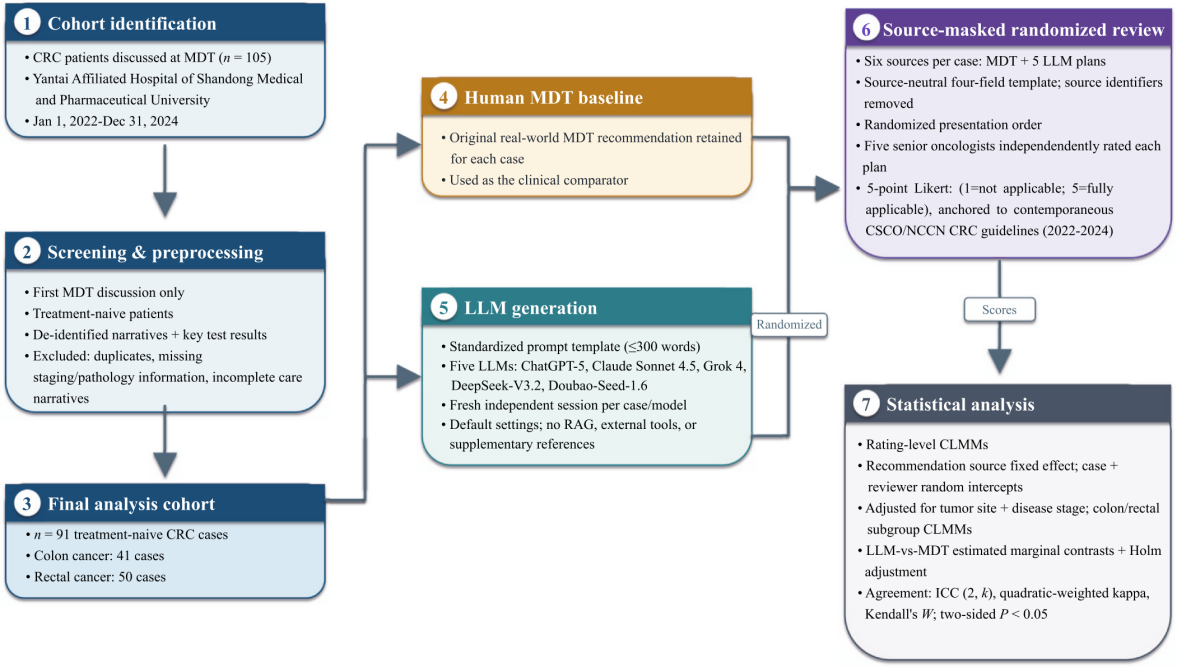
In Intelligent Oncology (Volume 2, Issue 4, 2026), Zheng Zhang and colleagues compared recommendations from five LLMs with the original multidisciplinary team (MDT) recommendations for 91 patients who had yet to receive treatment.
Research highlights
1. The retrospective study drew on 41 colon and 50 rectal cancer cases discussed at one hospital from 2022 to 2024. DeepSeek-V3.2, Doubao-Seed-1.6, ChatGPT-5, Claude Sonnet 4.5, and Grok 4 each received the same de-identified case summary and prompt once per case.
2. Five oncologists independently scored each recommendation on a five-point scale with no source labels. They reviewed plans in a standardized format and referred to the Chinese Society of Clinical Oncology and National Comprehensive Cancer Network guidelines applicable at the time of the original decisions.
3. All five models had higher cumulative odds of receiving a higher guideline-concordance rating than the original MDT recommendations. Adjusted odds ratios ranged from 9.7 to 25.7, with all Holm-adjusted P values below 0.001.
4. Descriptive score differences were largest for rectal cancer. The original MDT recommendations had the highest agreement among reviewers, as measured by the intraclass correlation coefficient.
A key takeaway
LLMs could help tumor boards check documented plans against guidelines and flag decisions that need a clearer recorded rationale. The study measured how reviewers scored written recommendations. Clinical safety and patient outcomes remain open questions.
Looking ahead
Prospective multicenter studies could test whether these tools improve guideline review and documentation under clinician oversight. Repeated model runs and formal checks of source masking would clarify how reproducible the findings are. Future evaluations could also examine clinical safety and patient outcomes.
Read the full article on ScienceDirect
https://doi.org/10.1016/j.intonc.2026.100090
Contact information for Intelligent Oncology
LinkedIn: @IntelligentOncology
Bluesky: @Intelligent Oncology
X: @IntelligentOnco
Facebook: @intelligentoncology
Email Address: editorialoffice@intelligent-oncology.net
Journal website: https://www.sciencedirect.com/journal/intelligent-oncology
Submit a manuscript: https://www2.cloud.editorialmanager.com/intonc/default2.aspx
