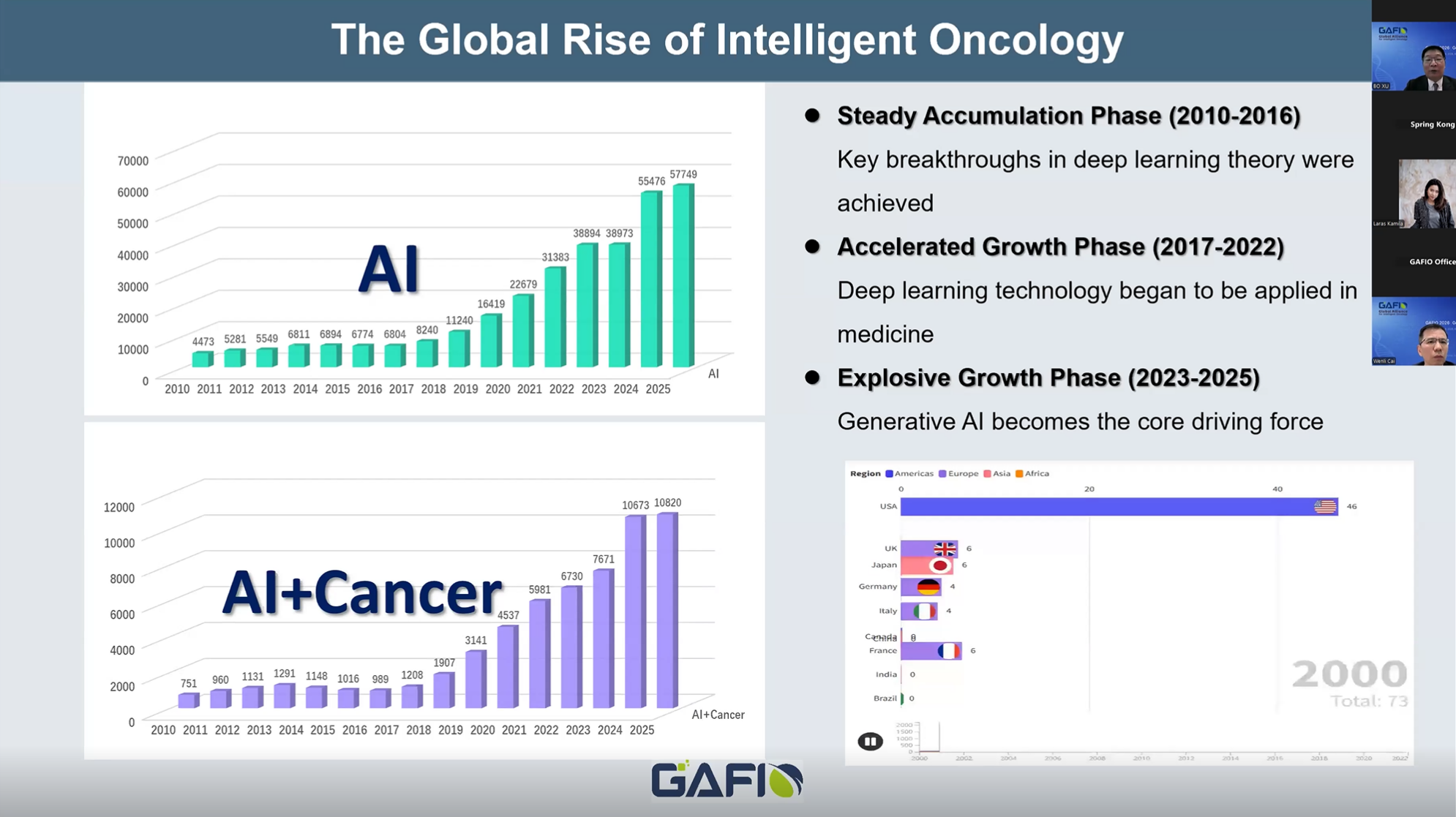
At the GAFIO General Assembly on February 9, 2026, Professor Bo Xu, President of GAFIO and Founding Editor-in-Chief of the journal Intelligent Oncology, delivered a keynote address outlining a transformative vision for the future of cancer care through global collaboration in artificial intelligence (AI).
Addressing a global online audience across multiple time zones, Professor Xu opened by acknowledging the power of international connection before diving into a detailed 20-minute keynote speech on the core mission and strategic framework of GAFIO.
Key Highlights from the Address:
· Defining "Intelligent Oncology": Professor Xu framed the field around tackling three major challenges in healthcare: inefficiency, uncertainty, and the unknown. He described Intelligent Oncology as a systematic integration of core AI technologies (machine learning, deep learning, LLMs), their applications across the entire cancer care continuum (from prevention to treatment), and the critical pillars of data governance, regulation, and next-generation training for physician-scientists.
· The Imperative for Global Collaboration: Highlighting the explosive growth in AI-cancer research since 2015, Professor Xu noted that while pioneering work is concentrated in a few nations, there is a "global need for applying these technologies in many more countries." He positioned GAFIO—the Global Alliance for Intelligent Oncology—as the essential non-profit organization to bridge this gap, accelerate clinical translation, and foster interdisciplinary collaboration.
· From Concept to Clinical Impact: The speech showcased tangible examples of AI's potential, including:
o AI-powered systems for early cancer detection in endoscopic imaging, deployable even in resource-limited settings.
o "Digital biopsies" using CT scans to predict pathological subtypes, reducing the need for invasive procedures.
o Predicting genetic mutations (e.g., BRCA status) from standard histology slides, which could dramatically reduce testing costs and expand access to targeted therapies.
· GAFIO's Strategic Pillars: Professor Xu detailed the Alliance's concrete plans to drive progress through four key channels:
1. Research: Supporting innovative projects, multi-center clinical trials for AI devices, and building large-scale, collaborative data partnerships to overcome current limitations in data quality and bias.
2. Education: Launching fellowship programs, scholarships, and interactive webinars to train the next generation of oncologists and data scientists.
3. Academia-Industry Collaboration: Creating co-development labs and forums like the GAFIO Innovation Forum to validate technologies and matchmake partners.
4. Policy & Advocacy: Developing frameworks for data sharing, patient privacy, and ethical governance to responsibly integrate AI into global healthcare systems.
· A Vision for "High-Performance Medicine": Concluding with a forward-looking slide, Professor Xu contrasted today's experience-heavy medical system with a future state of "High-Performance Medicine." This future, powered by AI and big data, promises a healthcare ecosystem that is more efficient, certain, and capable of discovering the unknown—directly addressing the three core challenges he outlined.
Professor Xu's speech served as both a clarion call and a roadmap, reinforcing GAFIO's mission to reshape the cancer care ecosystem. His presentation underscored the critical window of opportunity to harness AI not just for technological advancement, but for creating a more equitable, effective, and collaborative global fight against cancer.
