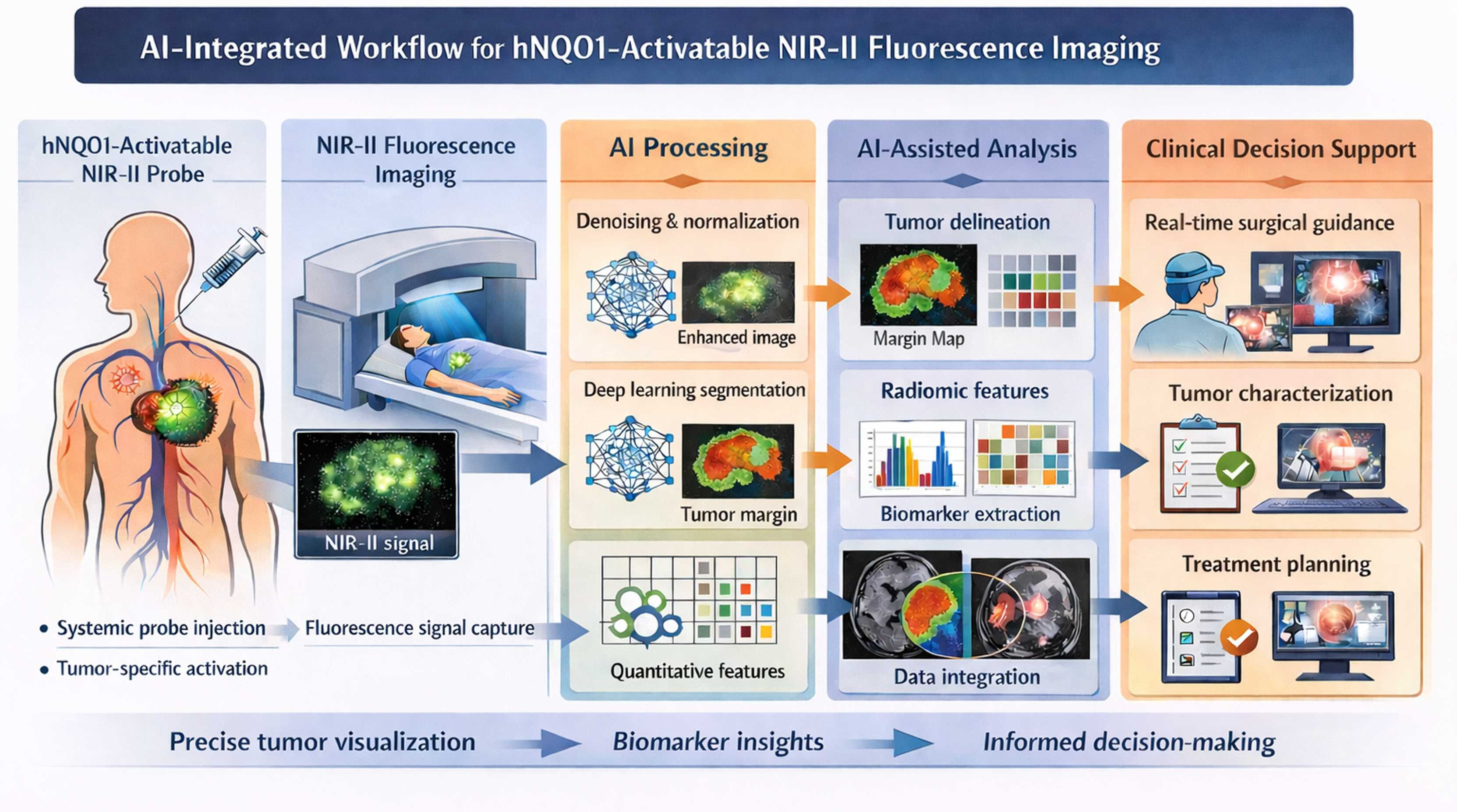
A new review published in Intelligent Oncology (Volume 2, Issue 2, 2026) highlights a powerful convergence of molecular imaging and artificial intelligence that could reshape how we detect, visualize, and treat cancer.
Led by David B. Olawade (University of East London) and an international research team, this work explores the emerging role of hNQO1-activatable NIR-II fluorescent probes in precision oncology.
The authors envision an intelligent oncology workflow that fuses hNQO1‑activated fluorescence with multimodal imaging (MRI, PET, CT) via advanced AI frameworks. Key goals include:
Validating AI‑derived quantitative biomarkers in large‑scale, multicenter prospective cohorts with pathology‑confirmed ground truth.
Standardizing NIR‑II imaging protocols and fluorescence data acquisition to improve model generalizability across institutions.
Using enzyme‑activity heterogeneity maps and temporal activation profiles for real‑time intraoperative margin assessment and residual disease detection.
Moving from qualitative fluorescence visualization to direct, quantitative mapping of functional endpoints (e.g., complete resection rate, disease‑free survival, and pathological complete response).
The ultimate aim is not to replace existing imaging modalities, but to provide complementary, molecularly specific, and real‑time functional guidance—especially for challenging surgeries, early‑stage tumor detection, and patients with heterogeneous hNQO1 expression profiles.
Full article available on ScienceDirect:
https://doi.org/10.1016/j.intonc.2026.100053
Contact Information for Intelligent Oncology:
LinkedIn: @IntelligentOncology
X: @IntelligentOnco
Facebook: @intelligentoncology
Email Address: editorialoffice@intelligent-oncology.net
Official Website: https://www.sciencedirect.com/journal/intelligent-oncology
Submission Link: https://www2.cloud.editorialmanager.com/intonc/default2.aspx
