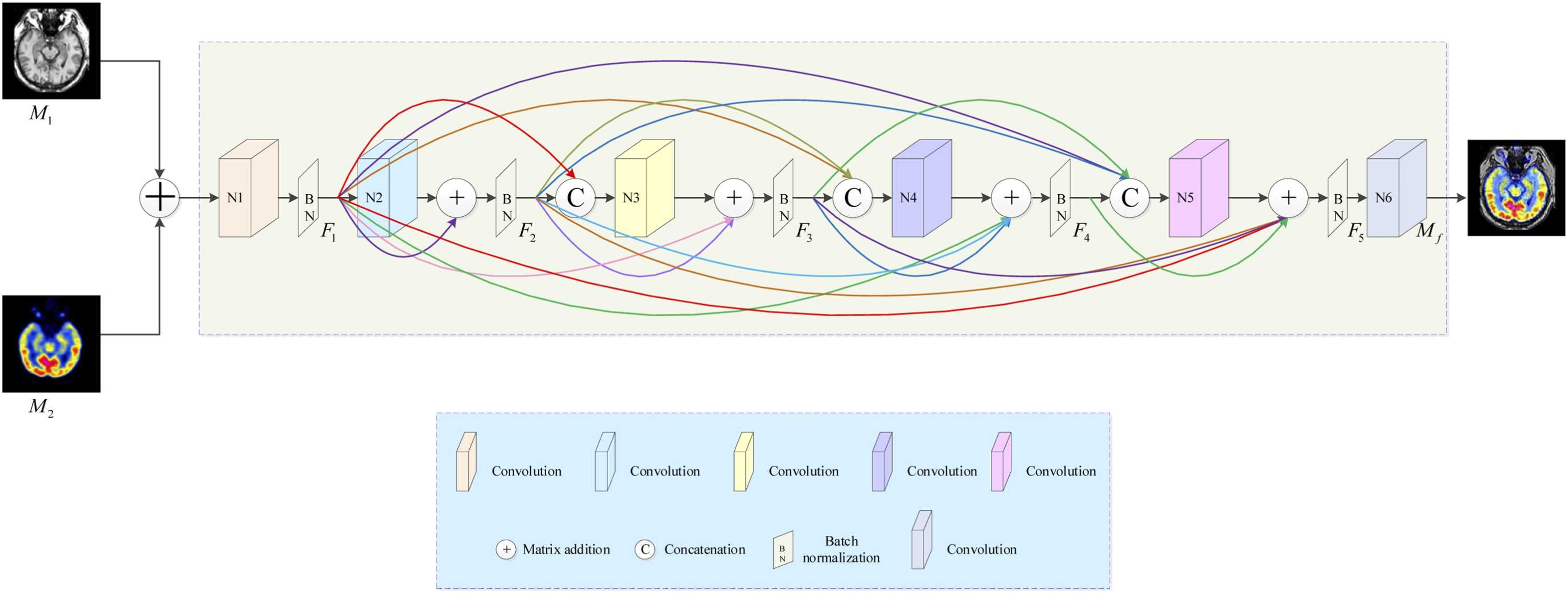
A study published in Intelligent Oncology introduces MRDFN, a multiscale residual dense fusion network that fuses multimodal medical images in just 0.07 seconds per pair while achieving 2.0× the average gradient of competing algorithms — promising a major boost for multimodal diagnosis.
Background
Different medical imaging modalities (CT, MRI, PET, SPECT) offer complementary information, but each alone is incomplete. Image fusion integrates these into a single composite view, aiding tumor diagnosis and treatment planning. Traditional methods, however, suffer from information loss, blurred edges, and low efficiency.
Study Overview
Researchers developed MRDFN, an end-to-end network combining multiscale feature extraction, residual connections, and dense connectivity. It is trained with three complementary losses (MSE, SSIM, gradient difference) — no manual fusion rules needed.
Key Findings
On MRT1-PET, MRT2-PET, and MRT2-SPECT pairs, MRDFN ranks first in average gradient, spatial frequency, and other key metrics — up to 2.3× higher than reference methods.
Fused images show richer color, clearer white/gray matter structures, and better-defined lesions.
Average fusion time is only 0.07 seconds per pair, demonstrating real-time potential.
MRDFN simplifies multimodal fusion workflows and could be integrated into clinical decision support and telemedicine systems, accelerating precision oncology.
Full article available on ScienceDirect:
https://doi.org/10.1016/j.intonc.2026.100054
Contact Information for Intelligent Oncology:
LinkedIn: @IntelligentOncology
X: @IntelligentOnco
Facebook: @intelligentoncology
Email Address: editorialoffice@intelligent-oncology.net
Official Website: https://www.sciencedirect.com/journal/intelligent-oncology
Submission Link: https://www2.cloud.editorialmanager.com/intonc/default2.aspx
