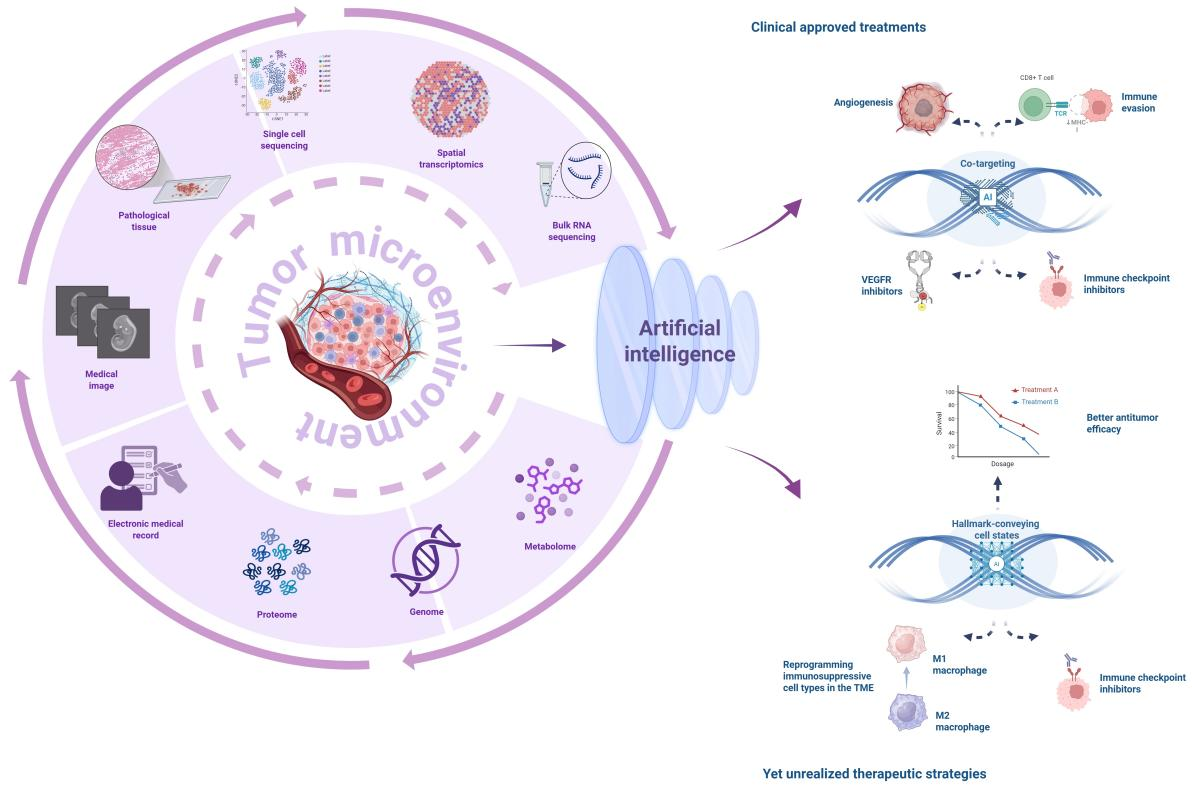
In a new editorial published in Intelligent Oncology, the journal’s editor-in-chief, Professor Bo Xu, presents a compelling vision for the future of cancer research: artificial intelligence (AI) as a unifying, quantitative “meta-lens” that transforms the multidimensional hallmarks of cancer into clinically actionable insights.
Building on the latest 2026 update to the hallmarks of cancer framework, the authors highlight a paradigm shift—from a descriptive list of tumor traits to a four-dimensional systems model encompassing acquired capabilities (1), enabling phenotypic characteristics (2), the tumor microenvironment (3), and systemic interactions (4). This expanded framework reflects the true complexity of cancer as a dynamic, multiscale disease.
The editorial illustrates how AI is uniquely positioned to address the challenges posed by modern oncology data:
In Dimension 1, AI models such as deep neural networks quantify hallmark activities directly from transcriptomic data, enabling precise molecular characterization beyond traditional staging.
In Dimensions 2 and 3, AI deciphers the tumor microenvironment by integrating single-cell and spatial multi-omics data, revealing the complex interplay between cancer cells and stromal, immune, and microbial components.
In Dimension 4, AI extends analysis to the whole organism, modeling systemic effects such as immunosuppression and cachexia through emerging approaches like virtual cells.
By bridging these dimensions, AI does more than analyze data—it reconstructs the biological logic of cancer across scales, from genes to systems.
Importantly, the authors emphasize the clinical implications of this convergence. AI-driven hallmark profiling has the potential to guide therapy selection, stratify patients, and enable a new generation of hallmark-informed clinical trials.
As cancer research enters the era of data abundance, this work positions AI not simply as a tool, but as an essential framework for understanding and treating cancer. The integration of AI with the hallmarks paradigm marks a decisive step toward intelligent oncology—where complexity is not only captured, but translated into precision medicine.
Full editorial available on ScienceDirect:
https://doi.org/10.1016/j.intonc.2026.100052
Contact Information for Intelligent Oncology:
LinkedIn: @IntelligentOncology
X: @IntelligentOnco
Facebook: @intelligentoncology
Email Address: editorialoffice@intelligent-oncology.net
Official Website: https://www.sciencedirect.com/journal/intelligent-oncology
Submission Link: https://www2.cloud.editorialmanager.com/intonc/default2.aspx
